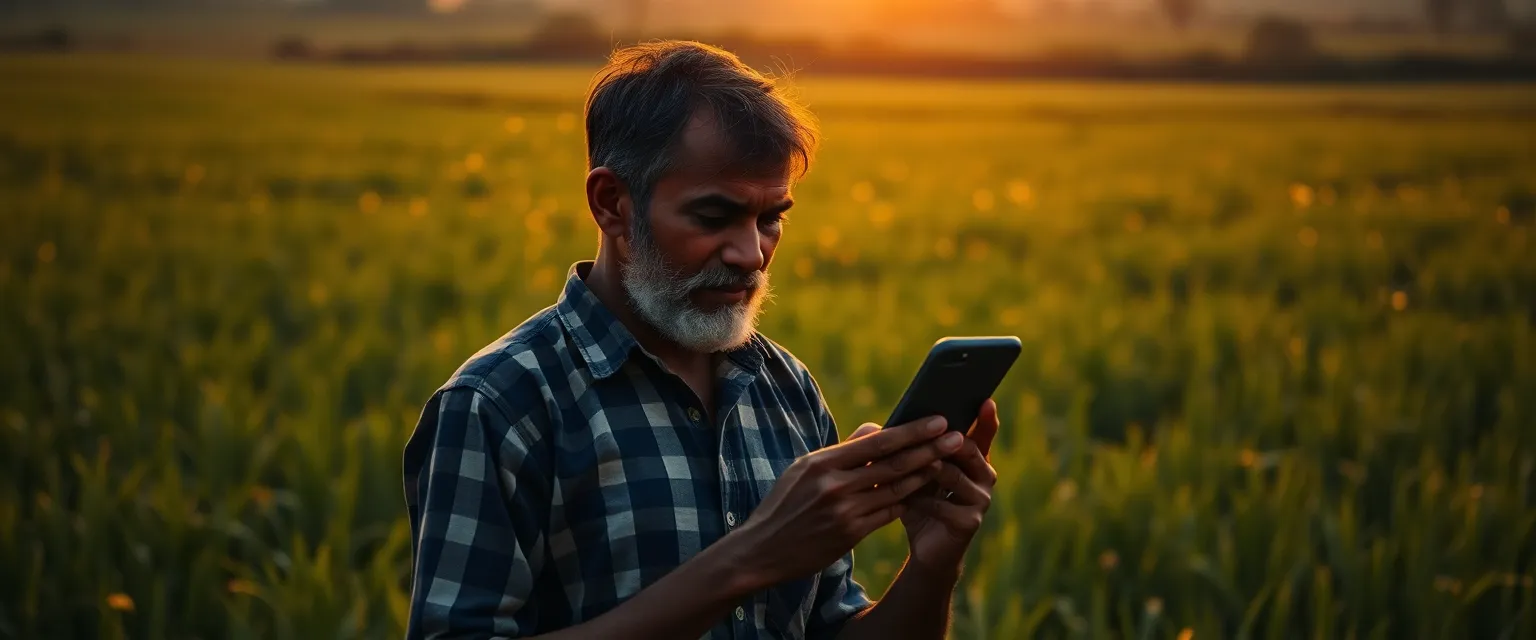
Agricultural extension — getting good advice to the farmer — has always been the weakest link. India runs barely one extension worker for every thousand-plus farms, and public extension reaches only a small fraction of households. In 2015 this blueprint named mobile extension services as Prerequisite #8. A decade later, AI and machine learning are what finally make personalised advice affordable for every farmer — and countries around the world are proving it.
Why it matters
Most farmers never meet an extension agent. The cost of one-to-one advice has always capped its reach — until a model could give it to millions at once, in their own language.
6.8%
of Indian farm households reached by public extension
1 : 1,162
extension officers to operational holdings
+22%
input adoption from digital advice (RCT meta-analysis)
A hundred-year human mission
Before the algorithms, there were people — agents on bicycles, contact farmers, science centres in every district. Extension is one of the oldest development ideas there is, and every generation rebuilt it. To see why AI matters here, you have to see what it completes: a century of trying to carry knowledge the last mile, always defeated by the same arithmetic.
The idea — knowledge as a public good
Extension began as a promise: that the discoveries of agricultural science would not stay in the laboratory but be carried, field by field, to every farmer. America's land-grant colleges built the first cooperative extension service; the FAO carried the model across the world. The principle has never changed in a century — the bottleneck was always the cost of delivering it.
The lesson: The mission is old; only the delivery is new.
The big bet — Training & Visit
The World Bank backed the largest extension experiment in history: a disciplined fortnightly cascade from subject experts to village 'contact farmers,' spread across more than 70 countries. Where it ran, it lifted yields. But it was crushingly expensive to sustain, and when donor funding ebbed most systems decayed — 'good intentions and hard realities,' as the Bank's own post-mortem put it.
The lesson: A model that only works while the money flows is not a model.
India's living network — KVKs and ATMA
India built the most extensive public extension architecture on earth: ICAR's network of ~730 Krishi Vigyan Kendras — district farm-science centres that demonstrate and train — feeding a state machinery that, since 2005, runs through ATMA, a decentralised, farmer-driven district model. The network is real and irreplaceable. It is simply spread far too thin to reach everyone.
The lesson: The human network is the asset; its reach is the problem.
Doing more with less — field schools & farmer-to-farmer
If you cannot put an officer in every village, let farmers teach farmers. FAO's Farmer Field Schools — season-long, hands-on, in the field — have reached farmers in over 90 countries. Digital Green turned the same instinct into community-made video, screened by a local mediator: in trials it drove adoption up to ten times more cost-effectively than classic extension. Knowledge scales when it is made cheap to copy.
The lesson: Make the knowledge cheap to copy and the network scales itself.
The unfinished mission
A century on, the promise is still unkept. In India public extension reaches only about 6.8% of farm households, with roughly one officer for every 1,162 holdings — and women and the smallest farmers least of all. Every model worked; none could beat the arithmetic of one expert and a thousand farmers. That ceiling — the cost of one-to-one human advice — is exactly what AI now lifts: not by replacing the KVK officer or the lead farmer, but by giving each of them a tireless assistant, and giving every farmer a voice to ask.
The lesson: AI does not replace the human network — it removes its cost ceiling.
Each era proved the same thing: the human network of officers, KVKs and lead farmers is irreplaceable — and forever capped by the cost of one expert reaching many farmers. What follows is that ceiling being lifted, country by country.
Six ways AI is doing extension
Conversational AI advisory
A large-language-model adviser in the farmer's own language and voice — answering agronomy and scheme questions at any hour, on the phone the farmer already owns. This is Prerequisite #8 made real.
Digital Green — Farmer.Chat
A GPT-4 assistant on WhatsApp that answers voice or text questions with localised, evidence-grounded agronomy and scheme advice.
250,000+ farmers and extension agents; ~7 in 10 acted on its advice within 30 days.
↗ Source: Digital Green (with Gooey.AI), arXiv preprintKisan e-Mitra (PM-KISAN)
The first AI chatbot wired into a central flagship scheme — answering eligibility, payment and policy questions by voice or text.
~20,000 queries a day in 11 languages, powered by the Bhashini language stack.
↗ Source: IndiaAI, Ministry of Electronics & IT, Govt of IndiaJugalbandi (Microsoft + AI4Bharat)
A WhatsApp generative-AI bot that lets a villager ask, in their own language, which government programmes they qualify for.
Expanded to 10 languages and 171 government programmes from a single village pilot.
↗ Source: Microsoft Source Asia (with AI4Bharat)Computer-vision diagnosis
Point a phone at a sick plant or a pest trap and the model names the disease and the remedy — putting a plant doctor in every pocket, even offline.
PlantVillage Nuru (Penn State + FAO)
An offline phone app that diagnoses cassava disease and fall armyworm from the camera — no signal needed.
Out-diagnosed extension agents (65% vs 40–58%) and farmers (18–31%) in field tests.
↗ Source: Frontiers in Plant Science (PMC, open access) — PlantVillage, Penn State + FAOPlantix
Farmers photograph a damaged crop; a deep-learning model identifies the pest, disease or deficiency and advises treatment.
~800 symptoms across 60+ crops; used by millions of Indian farmers in local languages.
↗ Source: PEAT GmbH, BerlinFAO FAMEWS + Nuru
In-field AI diagnosis feeds an FAO platform that maps fall-armyworm outbreaks in real time for early warning.
Turns scattered farm scouting into a live continental early-warning map.
↗ Source: FAOPredictive ML agronomy
Machine learning fuses decades of weather, soil and crop data to tell a farmer when to sow and how to manage the crop — advice that used to need an agronomist standing in the field.
Microsoft + ICRISAT AI Sowing App
ML fused 45 years of rainfall with weather models to text groundnut farmers the optimal sowing date — no new hardware.
~10–30% higher yields in pilots, delivered by plain SMS.
↗ Source: Microsoft News IndiaSaagu Baagu (WEF + Govt of Telangana)
An AI bot advisory plus soil and AI quality testing and a digital marketplace for chilli farmers.
~21% higher yield, with 9% less pesticide and 5% less fertiliser.
↗ Source: FAO Digital Villages Initiative (Govt of Telangana + World Economic Forum)Satellite + ML monitoring
When you cannot visit every field, you watch them from orbit. ML on satellite imagery estimates yields, verifies claims and targets support — extension without a field visit.
YES-TECH (PMFBY crop insurance)
Remote-sensing and crop models estimate paddy and wheat yields at the insurance-unit level for faster, fairer claim settlement.
Rolled out nationally from 2023, with technology-derived yield given a defined weight in claims.
↓ Source: Department of Agriculture & Farmers Welfare, Government of IndiaNovissi (World Bank · NASA Harvest · GiveDirectly)
Deep learning on satellite imagery plus ML on phone data found and paid the poorest farmers directly.
Reached 572,852 beneficiaries with emergency cash, targeted by algorithm.
↗ Source: World Bank (Results brief)ML credit & markets
For a smallholder with no collateral and no credit history, a model can read satellite and agronomic signals to extend credit, inputs and insurance together.
Apollo Agriculture
ML credit scoring on satellite and agronomic data replaces collateral, bundling inputs, advice and insurance.
Brings a full input-plus-advice package to smallholders banks would never score.
↗ Source: Apollo Agriculture (Kenya)The frontier — autonomous & precision
Where this is heading: models that don't just advise but act — growing crops and treating fields plant-by-plant, doing more with far less.
Wageningen Autonomous Greenhouse Challenge
AI algorithms remotely grew real crops, out-performing expert human reference growers.
Higher net profit and resource efficiency than the human growers they were measured against.
↗ Source: Wageningen University & ResearchJohn Deere See & Spray
Boom cameras and onboard computer vision detect each weed and fire only the relevant nozzle.
Cuts non-residual herbicide use by roughly half on average.
↗ Source: John DeereAI vs the humans it assists — crop-disease diagnosis
- Nuru AI app65%
- Extension agents40–58%
- Farmers (unaided)18–31%
PlantVillage Nuru field study: the app diagnosed cassava disease more accurately than extension agents or farmers working unaided.
Reported yield uplift from ML advisory
- AI Sowing App (pilot)+30%
- Saagu Baagu (chilli)+21%
- Digital advice (RCT meta)+4%
Programme-reported and trial figures; pilot results, not universal guarantees — shown to indicate the order of magnitude.
What India is already building
India is not watching this from the sidelines. Kisan e-Mitra, Bhashini, Saagu Baagu and YES-TECH are live, public, and at population scale — the AI-extension layer of the very cycle this blueprint described. Our own Farmer Cockpit is built in the same spirit.
How it fits the cycle
AI extension is not a gadget bolted on — it is how the advisory and feedback steps of the Annual Agri Cycle actually reach every farmer. It strengthens the prerequisites for soil, sowing, insurance and price discovery all at once.
Sources — every example, verified
- ↗ Improving Agricultural Extension: A Reference Manual — FAO, 1997Global policy
- ↓ Agricultural Extension: Good Intentions and Hard Realities — The World Bank Research Observer, 2004Peer-reviewed
- ↗ Dept. of Agriculture & Farmers' Welfare (schemes & Digital Agriculture Mission) — Govt. of India
- ↗ Global Farmer Field School Platform — Overview — FAO, 2023Global policy
- ↗ Digital Green: Participatory Video and Mediated Instruction for Agricultural Extension — Information Technologies & International Development (ITID), 2009Peer-reviewed
- ↓ Improving Smallholder Agriculture via Video-Based Group Extension — Journal of Development Economics / J-PAL, 2020Peer-reviewed
- ↓ Transforming public agricultural extension and advisory service systems in smallholder farming — FAO, 2022Global policy
- ↓ Agricultural Extension and Support Systems in India (Discussion Paper 20) — MANAGE — National Institute of Agricultural Extension Management, Govt of India, 2020India policy
- ↓ Guide on digital agricultural extension and advisory services — FAO, 2022Global policy
- ↗ Realizing the potential of digital development: The case of agricultural advice — Science (open access via PMC), 2019Peer-reviewed
- ↗ Farmer.Chat: Scaling AI-Powered Agricultural Services for Smallholder Farmers — Digital Green (with Gooey.AI), arXiv preprint, 2024Peer-reviewed
- ↗ Exploring the Pradhan Mantri-KISAN AI Chatbot (Kisan e-Mitra) — IndiaAI, Ministry of Electronics & IT, Govt of India, 2023India policy
- ↗ With next-generation AI, Indian villagers gain easier access to government services (Jugalbandi) — Microsoft Source Asia (with AI4Bharat), 2023Best practice
- ↗ National Mission on Natural Language Translation (BHASHINI) — IndiaAI, Ministry of Electronics & IT, Govt of India, 2022India policy
- ↗ iNZIVA / Nuru: a deep-learning app for offline crop disease and pest diagnosis — Frontiers in Plant Science (PMC, open access) — PlantVillage, Penn State + FAO, 2020Peer-reviewed
- ↗ Plantix — AI photo-based crop diagnosis & advisory app — PEAT GmbH, Berlin, 2024Best practice
- ↗ FAMEWS — Fall Armyworm Monitoring & Early Warning System (with Nuru AI) — FAO, 2020Global policy
- ↗ Microsoft & ICRISAT's intelligent cloud pilot for agriculture in Andhra Pradesh (AI Sowing App) — Microsoft News India, 2017Best practice
- ↗ Saagu Baagu — AI-driven agriculture initiative for chilli farmers, Telangana — FAO Digital Villages Initiative (Govt of Telangana + World Economic Forum), 2024Global policy
- ↓ Yield Estimation System based on Technology (YES-TECH) Manual under PMFBY — Department of Agriculture & Farmers Welfare, Government of India, 2023India policy
- ↗ Togo's Novissi: ML, satellite and mobile data to target emergency cash to the poorest — World Bank (Results brief), 2021Global policy
- ↗ Apollo Agriculture — financing for profitable farming — Apollo Agriculture (Kenya), 2025Best practice
- ↗ Autonomous Greenhouse Challenge — AI for sustainable greenhouse production — Wageningen University & Research, 2024Best practice
- ↗ See & Spray — computer-vision targeted spraying — John Deere, 2025Best practice
Each programme links to an authoritative source (government, FAO/World Bank/WEF, or peer-reviewed). See the full Evidence Library for the complete set.