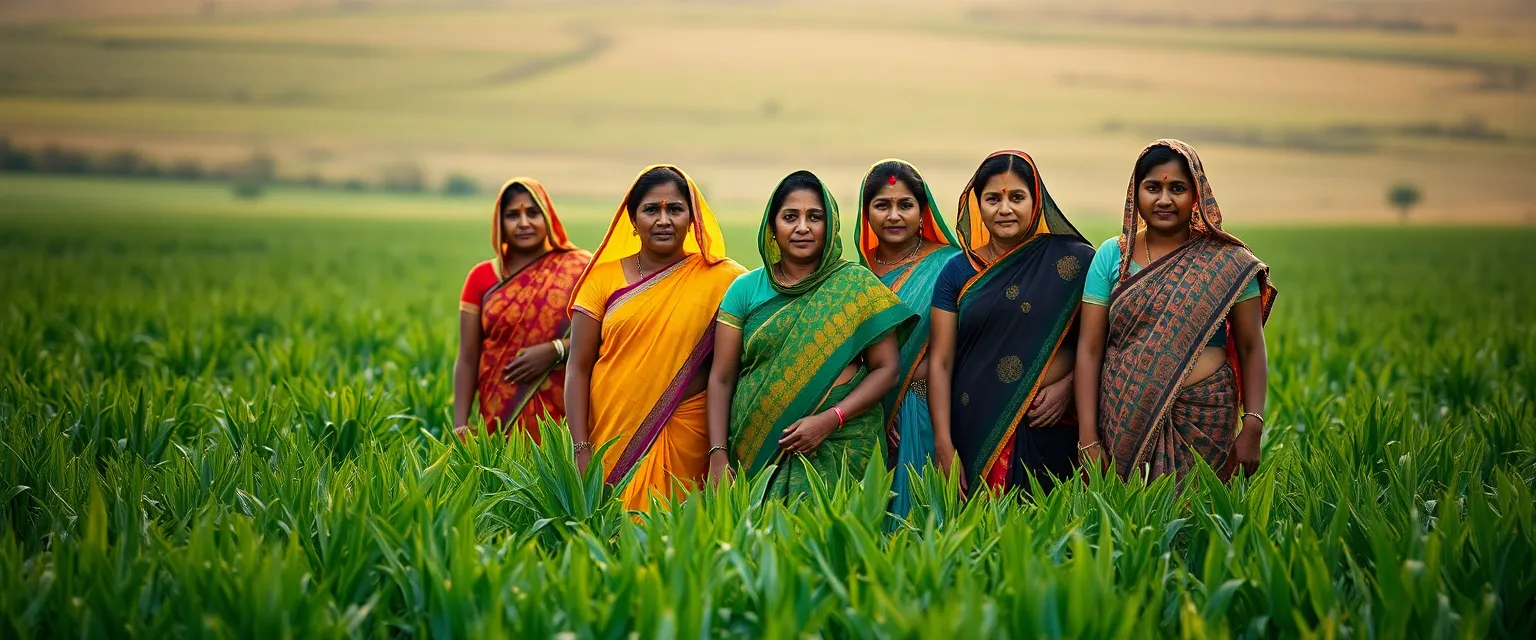
The 2015 deck did not mention women once. That was its largest blind spot — and correcting it changes how every other section on this site must be read. As men migrate to the cities, Indian agriculture is feminising: women are now a large and growing share of the farm workforce, and in rural India agriculture absorbs the majority of working women. Yet the system recognises a farmer through a land title — and titles overwhelmingly belong to men.
So the woman who plants, weeds and harvests is, on paper, not a farmer at all. And that one omission cascades through every rail this site describes.
0
times the 2015 deck mentioned women
The two bars that don’t match
The whole argument in one picture: women do a large share of the work, and own a small share of the land the system rewards.
- Share of the agricultural workforce≈40%
- Share of operational landholdings~14%
And the gap barely moves: women’s share of holdings crept from ~12.8% (2010-11) to ~13.8% (2015-16) — one percentage point in five years. Sources: ↗ Dept. of Agriculture & Farmers' Welfare ↓ MoSPI ↗ FAO
A blueprint for an evergreen revolution that does not name this is a blueprint for half a revolution.
The exclusion chain
It is not five separate problems. It is one — the missing title — falling like a row of dominoes through credit, insurance, identity and the market. Follow it link by link.
How Land title shuts her out
The system recognises a ‘farmer’ through a land record — and most records carry a man’s name. A woman who does the farming is, from the very first step, invisible to it.
The fix
Joint titling of land and real enforcement of inheritance rights — put her name on the patta.
One missing title, five locked doors. Tap each link to follow the cascade.
What is already turning it around
None of this is theoretical. Each of these exists today — the task is to make them the default, not the exception.
Joint titling & inheritance
The single most powerful lever: put her name on the land record. Joint pattas and enforced inheritance rights turn an invisible cultivator into a recognised farmer.
SHG & microfinance channels
Self-help groups extend credit without a land title behind it — joint-liability lending that reaches the women the Kisan Credit Card cannot.
Namo Drone Didi
Agri-drones placed with women’s SHGs as a service enterprise — spraying for a fee, owned and run by women. Technology routed deliberately through the invisible half.
Krishi Sakhi para-extension
Women trained as community agriculture resource persons — so the advisory that reaches a woman’s field comes, for once, from someone who shares her day.
Women’s quotas in FPOs
A reserved seat in the collective gives a landless or small woman cultivator the bargaining power, aggregation and market access she is denied alone.
What this means for the build
Designing so the invisible half is visible
A blind spot in a slide deck is an omission; a blind spot in software becomes the default that excludes. So the tools on this site are being shaped around her from the start, not retrofitted later.
Household-level accounts
Not one login per land title, but an account for the household — so the woman who actually plants, weeds and harvests is a first-class user, not a dependant of a record.
Women-named FPO membership
The co-op manager registers members by the person who farms, not only the person who owns — carrying her produce to the mandi in her own name.
Open the FPO manager →Voice-first, in Kannada
Where literacy and phone-ownership skew male, text-and-English shuts women out twice. Advisories must speak — in her language, on a shared phone.
The farmer cockpit →You cannot follow up on a patient you never examined. The next visit starts by naming her.