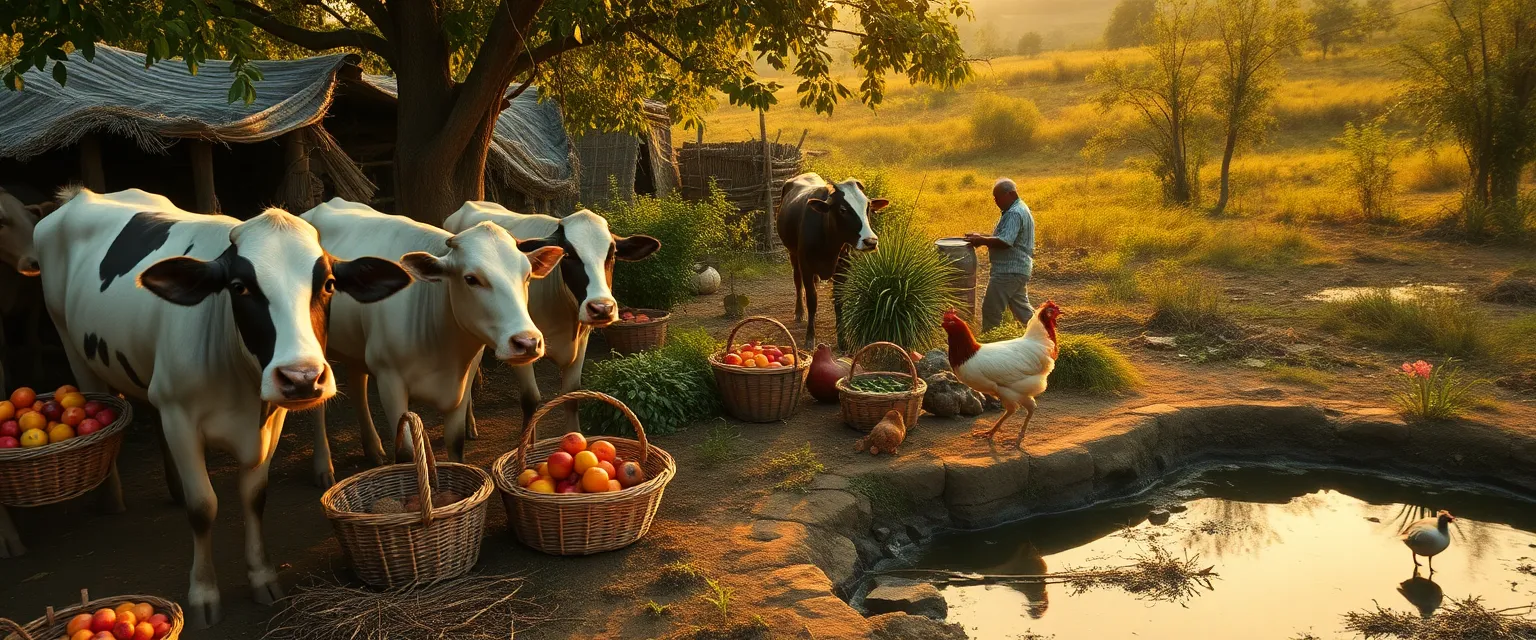
The 2015 deck — like most agricultural policy — says crops when it means agriculture. But the strongest income growth in Indian farming has come from almost everything except foodgrain: milk, poultry, horticulture, fisheries. India is the world’s largest milk producer; its horticulture output has outweighed all its foodgrains for over a decade. The central finding of the Doubling Farmers’ Income work was blunt — what moves a household’s income is diversification toward high-value activity, not yield alone.
And for a dry district, that is not only an income story. A buffalo, a poultry shed or a pomegranate acre is often the most rational drought hedge a family has — income that arrives monthly and barely depends on the monsoon.
#1
milk producer in the world — about a quarter of global output, ~239 MT a year
~355 MT
horticulture output — more than all foodgrains combined, for over a decade
~30%
of agriculture & allied GVA is now livestock — and rising, as the crop share falls
~18 MT
fish production — among the world’s top producers, the fastest-growing allied sector
The quiet structural shift
Most people picture Indian agriculture as fields of wheat and rice. But the composition of what the sector actually earns has been changing for two decades: crops still lead, but their share is falling as livestock and fisheries climb. This is the story the grain-first framing hides.
Where agriculture’s value comes from (indicative shares of GVA)
- Crops (incl. horticulture)~54%
- Livestock (dairy, poultry)~30%
- Fisheries & aquaculture~7%
- Forestry & logging~9%
Indicative shares of agriculture & allied GVA; the crop share has trended down while livestock and fisheries trend up. Source: ↗ Dept. of Economic Affairs ↗ Ministry of Fisheries
Build a household’s income
Take a model two-hectare family in the Central Dry Zone. Split the land between groundnut and ragi, add a few milch animals and some poultry, and watch what happens — not just to how much the household earns, but to how steady that income is across a good year and a bad one.
The rest goes to ragi — hardier, lower-value, far less thirsty.
Indicative annual net income
₹1.17 L
a year — likely between ₹90k and ₹1.45 L depending on the season
- Groundnut · 1.0 ha₹30k
- Ragi · 1.0 ha₹22k
- Dairy · 2 animals₹56k
- Poultry · 50 birds₹9k
56%
from allied (non-crop) sources
±47%
income swing — steadier than crop-only (±63%)
Illustrative net-income coefficients, for comparison only — actual returns vary widely by year, breed, market and management. The point is the pattern, not the rupee: allied activity adds income that arrives monthly and barely depends on the monsoon.
Notice the second number as you add animals: the income swing narrows. That is the whole argument — allied activity is the part of the farm least exposed to a failed monsoon. See why that matters →
What this means for the cycle
An agri cycle, not a grain cycle
If allied activity is where income and resilience live, then the Annual Agri Cycle cannot stop at foodgrain. The same rails the deck built for crops — identity, advisory, market access, insurance, aggregation — have to carry milk, eggs, fruit and fish too.
- The cooperative model already works. Operation Flood and Amul/KMF-Nandini showed that aggregation can lift a smallholder’s dairy income — the template the FPO module borrows.↗ NDDB
- It is the drought hedge. Water-light, monthly income is exactly what a family needs when the borewell falters — diversification and the evergreen test point the same way.
- It feeds the nutrition goal too. Milk, eggs and fruit are not just income — they are the protein and micronutrients the deck’s food-and-nutrition-security aim actually needs.
Grow grain to be food-secure. Grow everything else to be income-secure.