Swaminathan’s definition is unforgiving — productivity in perpetuity, without ecological harm. That single phrase makes climate and water the examination every other section on this site has to sit. The first Green Revolution traded groundwater for grain; the evergreen one has to grow more on a shrinking water budget, under a monsoon it can no longer count on.
“An evergreen revolution… productivity in perpetuity without associated ecological harm.”
The monsoon is changing character
It is not simply that there is less rain — it is that the rain has lost its rhythm. Fewer rainy days, heavier bursts, longer dry spells between them. For a kharif-dependent district like Chitradurga, where the year’s rainfall decides the year’s harvest, that volatility shows two faces of the same problem: a 2023-style mid-season dry spell shrivels the groundnut belt, while a 2021-style late deluge flattens standing ragi across southern Karnataka. Drought and flood, the same broken calendar.
A blueprint that assumes a dependable monsoon is planning for a country that no longer exists. The cycle has to be built for variance, not for an average.
The groundwater ledger
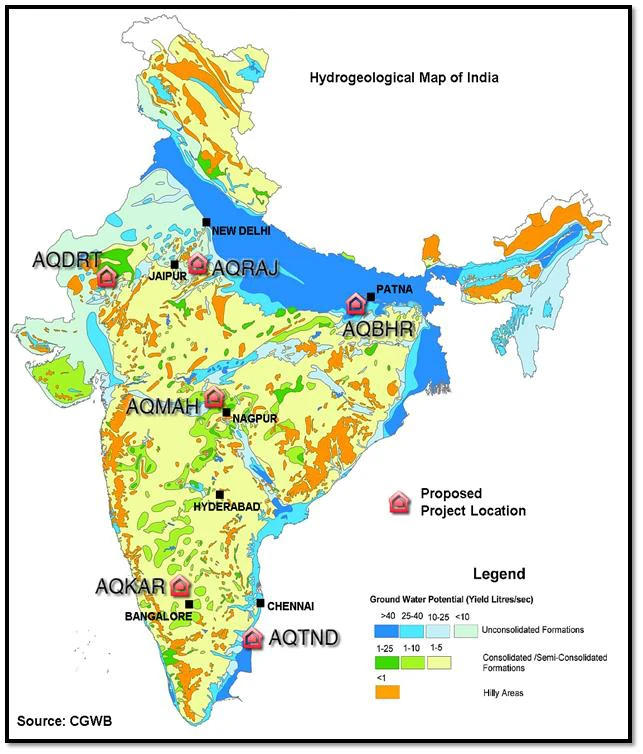
When the rain is unreliable, the farmer reaches for the borewell — and the borewell keeps a ledger. The Central Ground Water Board grades every assessment block from Safe through Semi-critical and Critical to Over-exploited, the point at which extraction outruns recharge. Across the peninsular hard-rock belt — Chitradurga included — the over-exploited category has been spreading. Borewell depth is the farmer’s private climate index: every dry year drives it deeper.
Chitradurga draws ~144% of what its rain returns
Every safe block stays at or below the 100% line. The district is pumping out roughly half again as much water as the monsoon puts back — borrowing from an aquifer with no lender of last resort. Nationally, groundwater supplies the majority of India’s net irrigated area, which is why this single number sits under almost every other promise on this site.
From the original 2015 deck
The millet answer
The crop that fails the evergreen test most badly is paddy; the crops that pass it most easily are the ones this dry belt grew for centuries. Millets — ragi, jowar, bajra — are low-water, heat-tolerant nutri-cereals that yield where rice would die of thirst. India proposed, and the UN declared, an International Year of Millets in 2023; Karnataka backs them on the ground with the Raitha Siri incentive of ₹10,000 per hectare, and pulls demand the other way by putting millets into the public distribution system. Supply-side science and demand-side pull, at last pointing the same way.
Water to grow one kilogram of grain
Indicative, relative — paddy can demand several times the water of a millet for the same kilo on the plate.
- Paddy · rice~3,500 L
- Maize~1,200 L
- Bajra · pearl millet~900 L
- Ragi · finger millet~800 L
Figures are illustrative orders of magnitude (ICRISAT / ICAR-IIMR); exact water footprints vary widely by region and method.
Run the test yourself
Pick a crop and a plot. The bars show what the crop needs against what a season’s rain can give — and the deficit a borewell has to make up. It is the evergreen test in miniature: which crops live within the rain, and which quietly draw down the aquifer.
Chitradurga averages roughly 570 mm a year — and not all of it falls when the crop can use it.
A season in the field
700 mm short
That gap is 70.0 lakh L for 1.0 ha — water that must come from a borewell every season, on top of the rain. Multiply it across a district and you are reading the groundwater ledger.
Indicative seasonal crop-water requirements (ET), for illustration only — actual needs vary with variety, soil, climate and irrigation method (FAO CROPWAT / ICAR). 1 mm of water over 1 hectare = 10,000 litres.
The adaptation toolkit
Passing the test is not one move but a kit — store the water, spend it precisely, grow the soil that holds it, plant in the right window, and insure against the year it still goes wrong. None of these is exotic; every one already exists as a programme. The work the cycle does is to assemble them around each field instead of leaving them scattered across a dozen departments.
Micro-irrigation — more crop per drop
Drip and sprinkler turn a borewell’s falling yield into precise, scheduled water. For groundnut in the Central Dry Zone it is not an upgrade — it is the only durable strategy. India has invoked the ‘Israel model’ in its micro-irrigation budgets for a reason.
Farm ponds — catch the burst, bridge the dry spell
When rain arrives in fewer, fiercer bursts, the answer is to harvest it. Karnataka’s Krishi Bhagya farm ponds let a rainfed farmer store a downpour and release it across the dry weeks that follow.
Agroforestry & soil cover
Trees on bunds, mulch and residue cover cut evaporation, hold soil carbon and shade the crop — buying back some of the water the heat takes away. The evergreen revolution grows the soil, not just the grain.
Sowing-window advisories — the citizen’s risk-zoning
Brazil conditions credit on planting in the right window for the crop, soil and climate. India’s IMD Agromet advisories carry the same intelligence to the block. This site’s own cockpit turns that into a per-field, plain-Kannada nudge.
Weather-index insurance & warehouse receipts
When the monsoon fails anyway, satellite-verified insurance (PMFBY / YES-TECH) pays without a claims inspector, and a warehouse receipt lets the farmer wait out a depressed price instead of selling distressed. Shock absorbers, not prophecy.
Grow more, on less water, forever. Everything else on this site is only a plan for how.