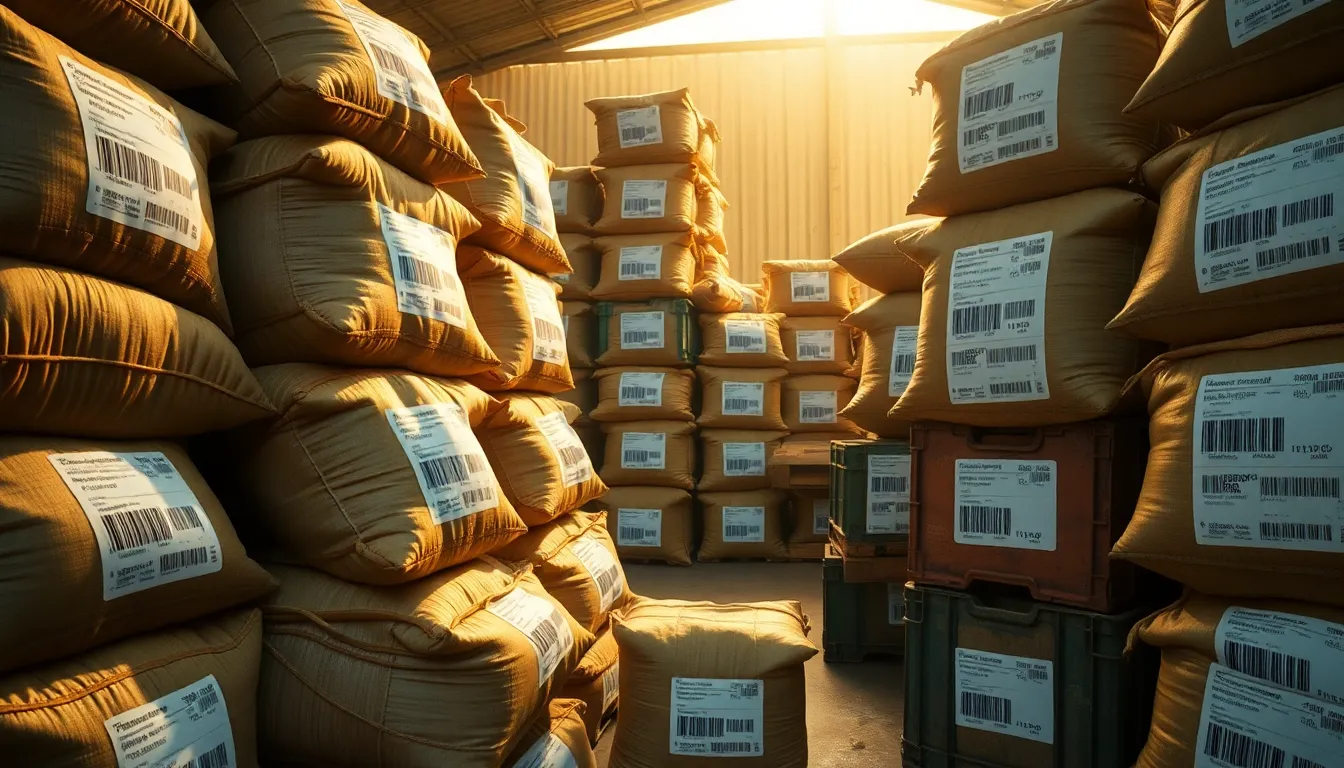
The 2015 proposal
RFID-coded tamper-proof packaging carrying farm, farmer, soil, crop, grade, buyer, warehouse and every transaction.
Where it stands in 2026
The market answered the deck’s question differently than it was posed — and more cheaply. Rather than an RFID tag on every sack, practice converged on lot-level QR/GS1 codes backed by trusted repositories: APEDA’s TraceNet and GrapeNet for export horticulture, and the electronic warehouse receipt (eNWR) for stored grain. Per-bag RFID economics suit a pallet of high-value goods, not a 30-kg sack of cereal where the tag can cost more than the margin. Internationally the governing templates are now regulatory rather than hardware — the EU General Food Law’s one-step-back / one-step-forward rule and the US FSMA traceability rule — which is the model India can follow.
The open gap
Per-bag RFID will never pay on a 30-kg sack; the open gap is one interoperable lot-ID honoured across every system.
The path to close it
Stop chasing per-bag RFID — the arithmetic never closes on a 30-kg sack — and standardise instead on a lot-level GS1/QR identity tied to the eNWR and the assay record, reserving RFID for pallets, containers and the cold chain where it pays. The real prize is interoperability: mandate one lot-ID honoured across APEDA TraceNet, GrapeNet, the eNWR system and e-NAM, so a single lot stays traceable from mandi gate to processor to plate without being re-keyed at every hop. Anchor it in the EU food-law and US FSMA one-step-each-way principle already in force abroad, and the result is tamper-evident provenance — the deck’s actual goal — at a cost a smallholder supply chain can bear.
Specifications — what “built” requires
Illustrative — a proposed specification and sequence, not an official government roadmap.
Acceptance criteria
- Every traded lot carries one interoperable, tamper-evident lot-ID (GS1/QR).
- That lot-ID is honoured across APEDA TraceNet, GrapeNet, eNWR and e-NAM without re-keying.
- The lot-ID links to the assay record and the warehouse receipt.
- One-step-back / one-step-forward traceability from mandi to plate (EU / US FSMA standard).
- RFID reserved for pallets, containers and the cold chain, where it pays.
Technical spec
- Identifier
- GS1/QR lot-ID (not per-bag RFID); tamper-evident seal
- Standard
- EU one-up/one-down + US FSMA traceability fields
- Linkage
- lot-ID ↔ assay ↔ eNWR ↔ e-NAM transaction
- Interop
- single ID schema across TraceNet / GrapeNet / eNWR / e-NAM
- RFID tier
- pallet / container / cold-chain only
- Registry
- central lot-ID resolver / repository
Roadmap to built — phase 1 → 2 → 3
Illustrative — a proposed specification and sequence, not an official government roadmap.
- 1Phase 1 · Now
One lot-ID schema
Standardise a single GS1/QR lot-ID with a central resolver.
Every lot gets one tamper-evident identity.
- 2Phase 2 · 6–12 months
Make it interoperable
Honour the lot-ID across TraceNet, GrapeNet, eNWR and e-NAM, linked to assay and receipt.
A lot stays traceable without re-keying at each hop.
- 3Phase 3 · 12–24 months
Mandate traceability
Require one-up / one-down tracing to EU / FSMA standard; reserve RFID for pallets and cold chain.
Mandi-to-plate provenance — built.
Where it sits in the chain
See the full map →Enables
Nothing yet — this is a capstone of the chain.
Sources
- ↗ WDRA — Warehousing Development & Regulatory Authority (eNWR) — Govt. of India
- ↗ Design of a Blockchain-Enabled Traceability System Framework for Food Supply Chains — Foods (MDPI, open access via PMC), 2022
- ↓ Food Traceability Guidance — FAO, 2017
- ↗ Food law general requirements (General Food Law, Reg. (EC) 178/2002, Art. 18 traceability) — European Commission, DG Health & Food Safety, 2024
- ↓ Guidance on the Implementation of Articles 11, 12, 14, 17, 18, 19 and 20 of Reg. (EC) 178/2002 — European Commission, 2010