The 2015 proposal
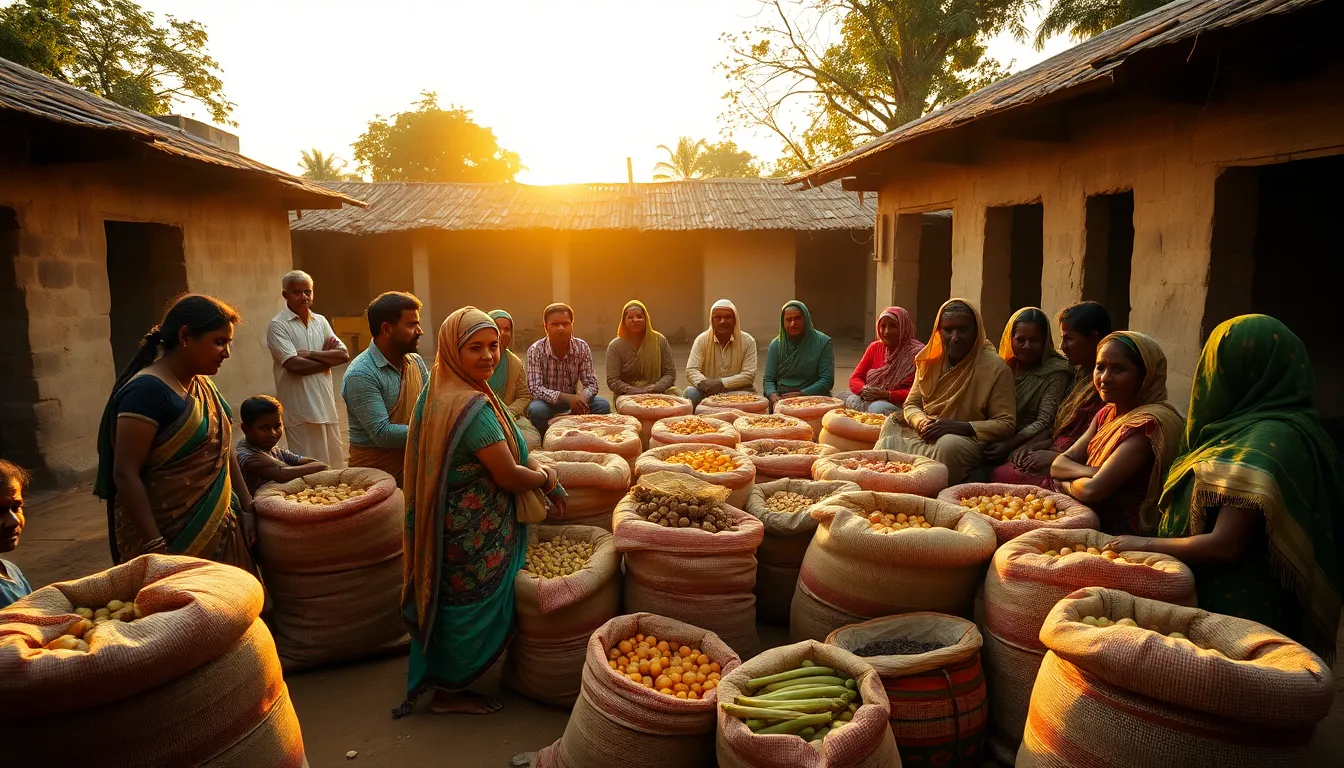
Farm co-operatives for shared inputs, labour and machinery, converged with MGNREGA — average-labour estimation, biometric attendance, drone videography of works and cashless pay.
Where it stands in 2026
India chose the Farmer Producer Organisation as its vehicle — the Central 10,000-FPO scheme, with 4,724 FPOs already transacting on e-NAM — to give scattered smallholders the scale they individually lack. Alongside it, VB-GRaM-G (formerly MGNREGA, in force from 1 July 2026) carries the rural-employment guarantee forward with geo-tagged NMMS attendance and Aadhaar-based wage payments, and agriculture convergence as stated policy. What no government tool yet does is plan labour at the cooperative level against the sowing calendar — which is exactly the gap this site’s tool prototypes.
The open gap
FPO business viability beyond grants is uneven; co-op labour planning is unbuilt.
How to sustain & deepen it
The make-or-break for FPOs is the journey from grant-dependence to genuine business viability: shared processing, branded farm-gate value addition and assured offtake contracts, so a collective earns from the market rather than the scheme. Build the cooperative-level labour planner this site prototypes so VB-GRaM-G’s guaranteed workdays converge with each season’s sowing and harvest peaks rather than running on a separate calendar. Strengthen FPO governance and professional management so the institution outlasts its founding subsidy — a cooperative that trades, processes and plans is what makes the smallholder count as a market player.
Where it sits in the chain
See the full map →Sources
- ↗ e-NAM (National Agriculture Market) — Ministry of Agriculture & Farmers' Welfare
- ↗ Dept. of Agriculture & Farmers' Welfare (schemes & Digital Agriculture Mission) — Govt. of India
- ↗ Governing the Commons: The Evolution of Institutions for Collective Action — Cambridge University Press, 1990
- ↓ Agricultural Cooperatives: Paving the Way for Food Security and Rural Development — FAO, 2012
- ↗ The impact of agricultural cooperatives membership on the wellbeing of smallholder farmers: empirical evidence from eastern Ethiopia — Agricultural and Food Economics (Springer), 2017
- ↗ National Cooperative Development Corporation (NCDC) — Ministry of Cooperation, Government of India, 2024